Geometry · 8 lessons
Similar triangles and enlargements
16 model write-ups · full exercise sheet (21 p.) and lighter version (11 p.)
Currently a mathematics teacher in France, I am planning to teach in Luxembourg. This portfolio reflects my day-to-day teaching through authentic classroom materials (written summaries, exercise sets, worked solutions and anonymised assessments for French 3e, i.e. ages 14–15: the equivalent of 5e in Luxembourg, S4 in the European Schools).
I favour explicit, structured teaching: I present methods directly, guide pupils as they put them into practice, and consolidate learning through sustained practice. Assessment then serves as a diagnostic tool to organise remediation — an approach and set of complementary resources designed to fit seamlessly into national curricula and official textbooks.
Below, I invite you to explore my approach across five pillars: understanding the course notes, mastering written reasoning, practising at one’s own pace, gaining independence and targeting individual needs. Each pillar is illustrated with real documents from my classes, which you can open without leaving the page.
When introducing a new topic, I guide pupils directly through the written summary. To remove barriers caused by mathematical symbolism, every piece of notation is verbalised using “On lit…” (“it reads…”) and then rephrased in everyday French using “En clair…” (“in plain words…”), through continuous dialogue with the class.
Whenever a property can be visualised, a dynamic figure helps highlight invariants: by observing what changes and what remains unchanged, pupils make sense of the rule. Below are four interactive examples from my 3e course notes (the equivalent of 5e in Luxembourg, S4 in the European Schools) on similar triangles and algebra, alongside the corresponding written material.Below is an interactive example from my 3e course notes on algebra (the equivalent of 5e in Luxembourg, S4 in the European Schools), alongside its written material.
Definition: two triangles are similar when their vertices can be matched in pairs so that the lengths of the corresponding sides are proportional. The constant of proportionality is the scale factor k > 0.
Angular characterisation: two triangles are similar if, and only if, their angles are equal in pairs.
Question put to the class, then tested on the figure from the course notes:
The segments [BD] and [CE] intersect internally at A, and (BC) ∥ (DE). The triangles ABC and ADE form the “butterfly” configuration.
In a square with n tiles along each side (n ≥ 2), only the outer border is tiled. Let C be the number of tiles in the border:
For all real numbers a and b: (a + b)2 = a2 + 2ab + b2. The term 2ab is called the double product.
These exchanges with the class lead to a summary, built up on the board according to a plan prepared in advance. For this, I draw inspiration from bansho (板書, “board writing”), a practice at the heart of mathematics lessons in Japan, taken up in other Asian countries such as Thailand, and then by teams of teachers in Europe and North America.
The aim is not to copy out the course notes: my pupils already have a printed copy. The board adds a summary built with the class and keeps what the course notes cannot contain: the path taken. It reads from left to right: the problem of the day, the pupils’ responses set side by side, the refuted errors, crossed out yet still legible, and then the summary. Nothing is erased during the lesson.
Pupils can thus review at a glance where we started, what was tried and why an idea was ruled out. The summary builds on their responses; they copy it down after the discussion, to complement the printed course notes. Preparing this board is also preparing the lesson: I plan where to write each idea, which questions to ask and what will remain visible.
Kadai: “Lengths, areas, volumes: multiplied by what?”
Quadrilateral on a grid, diagonal [BD]; area ABD = 12.
Reduction ×0,5: area = ?
We see it on a ×3 square:
side 1, area 1 → side 3, area 9 = 32
✗ : false (3 ≠ 6)
✓ 𝒜′ = 3 = 12 × 0,25 = 12 × 0,52
Proof (rectangle):
𝒜′ = (kL)(kℓ) = k × k × Lℓ
= k2 𝒜 (two dimensions)
1 dimension → k; 2 → k2; 3 → k3
Suspense from S3 resolved: 2.5 b): lengths × 43 ⇒ areas × (43)2 = 169 ✓
Scale factor k (A2): lengths ×k; angles preserved; areas ×k2; volumes ×k3.
Red line: the scale factor for areas is k2 (equal to k only if k = 1).
Reverse direction (A3): ratio of areas = k2, then find k > 0.
The board as planned for the end of the lesson. On the left, the problem; in the centre, the investigation and proof; on the right, the summary.At the top, the problem; then the investigation and proof; finally, the summary. Click on “Watch the board take shape” to follow the lesson step by step.
Because a rule memorised by rote does not last over time and an isolated result is never enough in mathematics, every property in the course notes is proved or justified.
To help pupils structure their written reasoning, I pair each family of exercises with a step-by-step model write-up. By having them put into words in class the question behind each step, and by keeping the exact same structure from the course notes through to the worked solutions, pupils build a reliable method of their own. Below is the model write-up for proving that two triangles are similar using two pairs of angles, taken from my chapter on similar triangles.
The points E, F, G are collinear in that order; the triangles EFM and FGN lie on the same side of the line (EG); (EM) ∥ (FN) and (FM) ∥ (GN).
1. Prove that FEM = GFN.
2. Prove that the triangles EFM and FGN are similar.
So that every pupil gains fluency without boredom or discouragement, my sets of exercises follow a fine-grained progression: from one exercise to the next, only one difficulty changes, and the chapter’s concepts are interwoven with those of previous chapters. The whole class works from the same exercise sheet, structured into three tracks (core, recommended, advanced) and gone over together using the same numbering. The aim is threefold: to bring struggling pupils up to the expected standard, to encourage the main body of the class to push themselves, and to allow the most advanced pupils to go further. A lighter version of the sheet keeps only the first two tracks; at the end of the sheet, extension challenges open the way towards the upper years.
To illustrate this progression, let us follow a single concept, the difference of two squares: (a + b)(a − b) = a2 − b2. It recurs throughout the exercise sheet on algebra. Here are four actual exercises, one per level, along with the worked solutions given to pupils; the last one, which goes beyond the 3e syllabus, itself refers back to the calculation of 102 × 98 from the core track. Choose a track to display its example.
Core track · exercise 4.1 · ★★☆☆
What I aim for with this track: making basic techniques automatic, so that pupils’ attention remains free for problem-solving.
Question exercise sheet on algebra
Calculate mentally, writing down the identity used, the calculation of each term and the result, then check.
c) 102 × 98 d) 103 × 97
The other six items focus on squares: 1012, 992, 212, 192, 352, 1 0012.
What this develops
Recognising a sum and a difference around a round number, writing down the identity before calculating, and checking the result using the units digit and order of magnitude.
Fully worked solution text from the worked solutions handed out
Method. Model write-up from the course notes: “mentally calculating a square or a product close to a round number”.
c) I use (a + b)(a − b) = a2 − b2 with a = 100 and b = 2, because 102 = 100 + 2 and 98 = 100 − 2.
Check: the units digit is that of 2 × 8 = 16, namely 6, and 9 996 is slightly less than 1002 = 10 000. ✓
d) I use (a + b)(a − b) = a2 − b2 with a = 100 and b = 3, because 103 = 100 + 3 and 97 = 100 − 3.
Check: the units digit is that of 3 × 7 = 21, namely 1, and 9 991 is slightly less than 1002 = 10 000. ✓
Recommended track · exercise 4.3 · ★★☆☆
What I aim for with this track: writing out a full solution, checking the plausibility of a result, and then generalising with a letter.
Question exercise sheet on algebra
A square of side 51 m contains a square of side 50 m, placed in one of its corners (diagram from the sheet, not to scale).
a) Mentally calculate the area of the grey border (the region between the two squares).
b) Before confirming: is this area plausible? The grey border is an L-shape made of two strips 1 m wide, along two adjacent sides only; estimate its area without an exact calculation, then compare with the result from a).
c) Generalise: for every real number n > 0, show that the area between a square of side n + 1 and a square of side n, arranged as in the diagram, is 2n + 1. Where have we already met this expression in the chapter?
What this develops
Expressing an area as the difference of two squares, calculating mentally, checking plausibility, and then generalising with a letter.
Fully worked solution text from the worked solutions handed out
Method. Model write-ups from the course notes: “writing up the solution to a problem” (questions a and b, using “calculating mentally by recognising the expanded form of an identity” for the calculation); “proving that an equality holds for every number” (question c).
a) I know that the large square has side 51 m and that the small square, placed in one corner of the large one, has side 50 m. I am looking for the area 𝒜 of the grey border: it is the area of the large square minus the area of the small square, so 𝒜 = 512 − 502, in m².
I use a2 − b2 = (a + b)(a − b) with a = 51 and b = 50: 𝒜 = (51 + 50)(51 − 50) = 101 × 1 = 101.
Conclusion: the grey border has an area of 𝒜 = 101 m².
b) Check: the grey border is made of two strips 1 m wide; each is about 50 m long, giving an area of about 2 × 50 × 1 = 100 m²: 101 m² is plausible. ✓
c) The area between the two squares is the area of the large square minus the area of the small square: I must prove that (n + 1)2 − n2 = 2n + 1. I expand the left-hand side.
I obtain the right-hand side. Therefore, for every number n > 0, the area between the two squares is (n + 1)2 − n2 = 2n + 1. ■
In the course notes, the expression 2n + 1 is the form of an odd number when n is an integer; it also appears in the expansion (n + 1)2 = n2 + 2n + 1 from exercise 2.1 h): it is what must be added to n2 to obtain (n + 1)2.
Advanced track · exercise 5.5 · ★★★★
What I aim for with this track: moving from a few examples to a proof that holds for all numbers, by choosing the most effective form.
Question exercise sheet on algebra
Anabelle claims: “The difference between the squares of two consecutive odd numbers is always a multiple of 8.”
a) Test the claim on (3 ; 5), (7 ; 9) and (11 ; 13).
b) Write two consecutive odd numbers in terms of an integer n, then prove that Anabelle’s claim is true. Hint: the factorisation a2 − b2 is faster than expanding; compare with the model in the course notes.
c) Where in the factorised result do we find the sum of the two starting numbers and the gap between them?
What this develops
Testing on examples, then proving for any integer; choosing the most effective form (factorising rather than expanding); interpreting the result.
Fully worked solution text from the worked solutions handed out
Method. Model write-ups from the course notes: “testing a claim on examples and making a conjecture” (question a); “proving a property of integers” (question b).
a) 52 − 32 = 16 = 8 × 2; 92 − 72 = 32 = 8 × 4; 132 − 112 = 48 = 8 × 6. All three differences are multiples of 8. ✓
b) Let n be any integer. Two consecutive odd numbers can be written as 2n + 1 and 2n + 3. I calculate the difference of their squares using the factorisation a2 − b2 = (a + b)(a − b), with a = 2n + 3 and b = 2n + 1:
Now, n is an integer, so n + 1 is an integer: 8(n + 1) is a multiple of 8. Therefore, for any integer n, the difference between the squares of two consecutive odd numbers is a multiple of 8: Anabelle’s claim is true. ■
c) In (4n + 4) × 2: the factor 4n + 4 is the sum of the two odd numbers, and the factor 2 is the gap between them: the difference of two squares can be written as “sum × gap”.
Key point. Another proof for b): expanding with (a + b)2 = a2 + 2ab + b2 gives 4n2 + 12n + 9 − (4n2 + 4n + 1) = 8n + 8. Now, 8n and 8 are multiples of 8; their sum therefore is as well, and 8n + 8 = 8(n + 1) makes the quotient explicit.
Going further · exercise 8.3 · ★★★★ · beyond 3e
What I aim for with this track: giving the fastest pupils material to explore and go beyond the curriculum; these exercises come with worked solutions just like the others.
Question exercise sheet on algebra
This exercise uses the upcoming number √7 (“square root of 7”), defined as the positive number whose square is 7: √7 × √7 = 7 (and √7 ≈ 2,65). The rest relies only on this chapter.
We want to rewrite B = 14 − √7 without a square root in the denominator.
a) Calculate (4 − √7)(4 + √7) using a notable identity and the given property.
b) By multiplying the numerator and the denominator of B by (4 + √7) (the conjugate expression of 4 − √7), write B without a square root in the denominator.
c) Which notable identity “makes it all work”? How does this method resemble the calculation of 102 × 98?
What this develops
Reusing the identity in a new context, with a square root: this is a technique that will become standard in later studies, and it refers explicitly back to the calculation of 102 × 98 in the core track.
Fully worked solution text from the worked solutions handed out
Method. Model write-up from the course notes: “expanding with a notable identity” (question a).
a) I use (a − b)(a + b) = a2 − b2 with a = 4 and b = √7.
b) The product calculated in a) is 9 ≠ 0, so both of its factors 4 − √7 and 4 + √7 are non-zero. The fraction is defined, and I can multiply its numerator and its denominator by 4 + √7:
Check: 4 − √7 ≈ 1,35, so B ≈ 0,74; and 4 + 2,659 ≈ 0,74. ✓
c) It is a2 − b2 = (a − b)(a + b) that “makes it all work”: it turns the denominator into 42 − (√7)2 = 16 − 7, an integer, because (√7)2 = 7. Same idea as 102 × 98 = (100 + 2)(100 − 2): I use “sum × difference” around an awkward number to make the inconvenient part disappear.
The full exercise sheets. Level: French 3e (ages 14–15), the equivalent of 5e in Luxembourg and S4 in the European Schools, with extensions towards higher year groups.
For homework to be genuinely worthwhile, my materials are designed to guide pupils when they are working on their own. My worked solutions do not merely give the final answer: they recall the reference model, explain the choice of mathematical tool, set out every step in detail, and include a final check of the result.
To build core fluency day by day, pupils also have access to digital self-tests and the “Gammes du soir” (evening drills), a routine of five quick questions with the answers printed upside down to encourage self-correction. Explore four examples below:Explore a few examples below:
Question: Here, a or b is a block in brackets. Factorise, then simplify each bracket (and factor out a number if possible): B = 25 − (2x + 3)2.
🔗 Link with the course notes: the model write-up “factorising with a notable identity” (algebra course notes, p. 18).End-of-chapter review on similar triangles: “A triangle with an area of 10 cm2 is enlarged by a scale factor of k = 3. What is its new area?”
5 short interleaved questions every evening (8 min, no calculator)
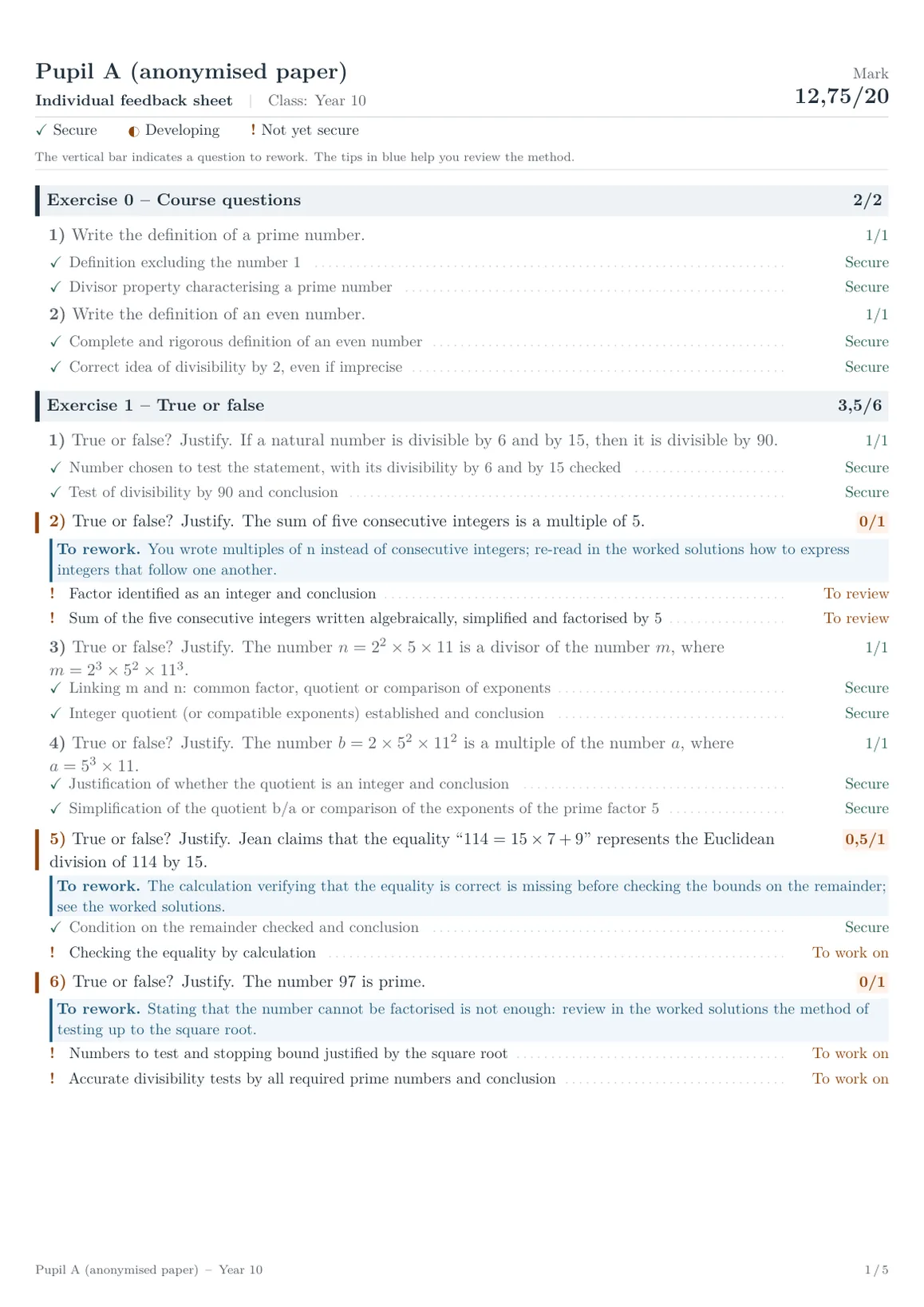
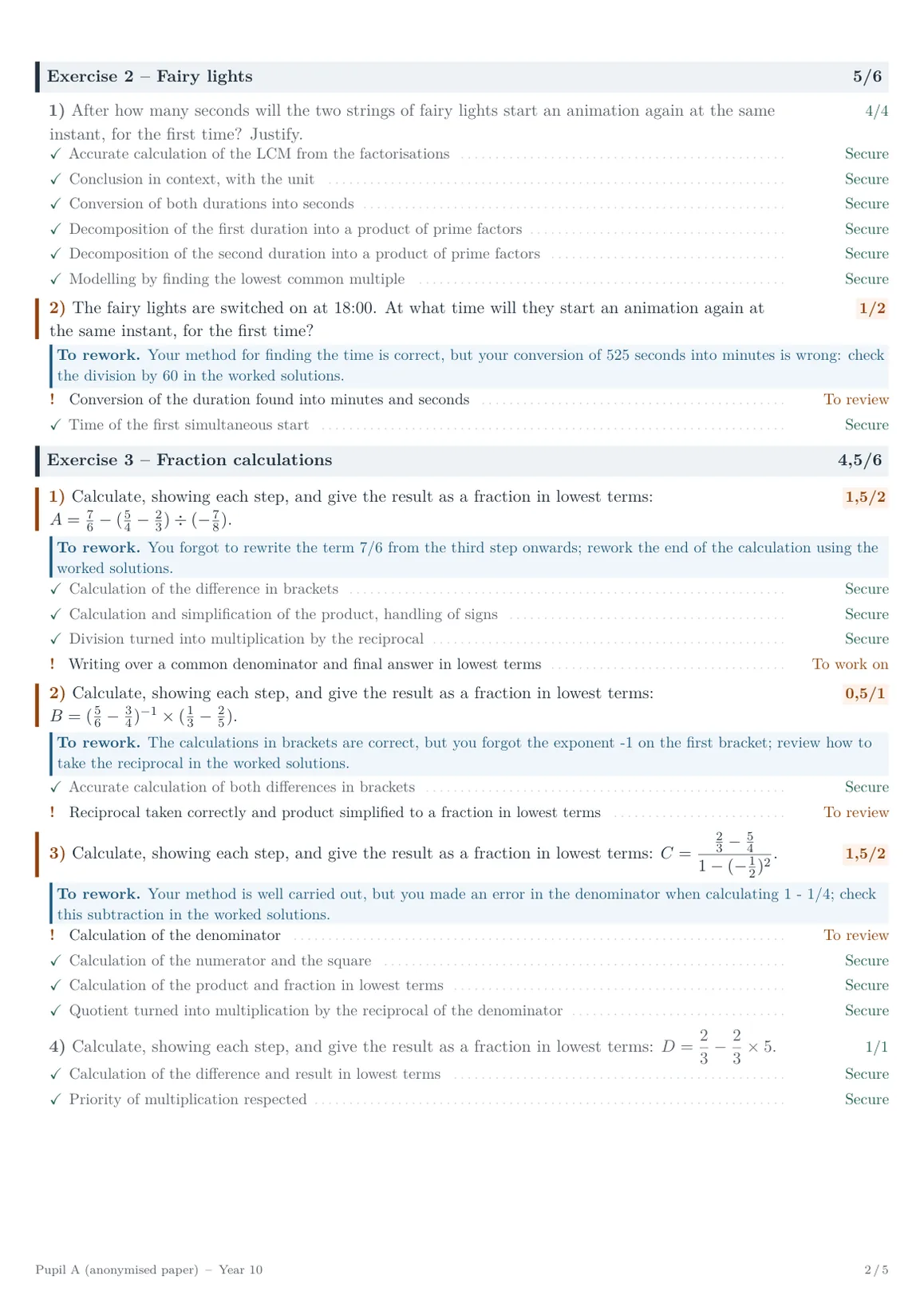
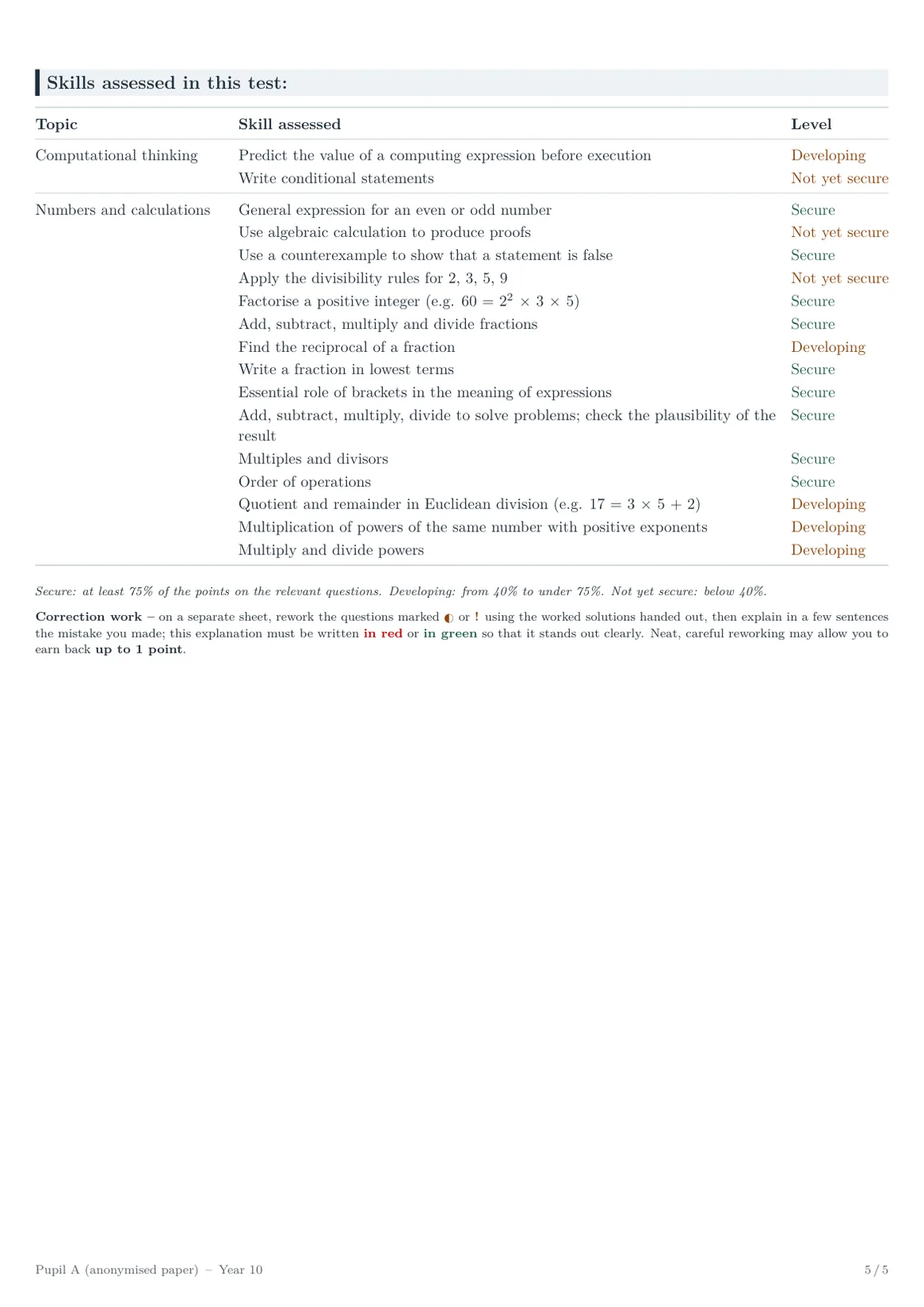
A numerical mark on its own neither tells a pupil how to improve nor tells the teacher what to target. For an in-class test, I mark each script by hand using a criteria-based grid, maintained in a spreadsheet, which breaks the marking scheme down into precise, observable indicators. This grid ensures complete consistency across scripts — which is particularly valuable for common tests — and allows both pupils and their parents to understand immediately how every mark was awarded.
This approach offers a twofold advantage: each pupil receives a clean document with targeted comments — a much-appreciated resource for reworking mistakes effectively using the fully worked solutions handed out — while the spreadsheet tools allow me to extract precise data easily so as to analyse what the class has mastered objectively, rather than relying on a mere impression. Combined with the analysis of my optically scanned multiple-choice tests, each assessment thus directly guides remediation. Two real examples:
Common test from October 2026 in 3e (the equivalent of 5e in Luxembourg, S4 in the European Schools): the same paper for all 3e classes in the school (arithmetic, fractions, powers, algorithms), designed as a team; I wrote one of the exercises. The pupil in this example scored 12,75/20, a mark close to the class average.
The sheets are generated through a marking workflow that I designed: a detailed criteria-based marking scheme, tips written for the pupil, LaTeX typesetting, and one sheet per pupil for the entire class. Marks follow the French scale: out of 20, with a pass mark of 10 (the equivalent of 30 out of 60 in Luxembourg).
Taken together, the criteria from all the feedback sheets build up a map of the example pupil’s class: 30 scripts, 28 questions (excluding presentation and the bonus question). Each row represents an anonymous pupil, from the highest mark at the top to the lowest at the bottom; each column represents a question.
| Exercise | What is assessed | Success rate |
|---|---|---|
| Ex. 0 | Definitions: prime number, even number | 76 % |
| Ex. 1 | True or false with justification (divisibility, Euclidean division, prime numbers) | 37 % |
| Ex. 2 | LCM problem: fairy lights | 78 % |
| Ex. 3 | Fraction calculations | 66 % |
| Ex. 4 | GCD problem: bouquets | 84 % |
| Ex. 5 | Euclidean division | 50 % |
| Ex. 6 | Powers and prime factorisation | 45 % |
| Ex. 7 | Algorithm: divisibility by 13 | 45 % |
| Ex. 8 | Position in a repeating pattern | 52 % |
| Question | Success rate | Secure | Developing | Not yet secure | Not attempted |
|---|---|---|---|---|---|
| 0.1 | 68 % | 14 | 13 | 1 | 2 |
| 0.2 | 83 % | 22 | 6 | 1 | 1 |
| 1.1 | 63 % | 18 | 2 | 9 | 1 |
| 1.2 | 23 % | 4 | 6 | 16 | 4 |
| 1.3 | 48 % | 12 | 5 | 10 | 3 |
| 1.4 | 37 % | 8 | 6 | 11 | 5 |
| 1.5 | 22 % | 0 | 13 | 13 | 4 |
| 1.6 | 27 % | 5 | 6 | 15 | 4 |
| 2.1 | 85 % | 26 | 1 | 2 | 1 |
| 2.2 | 65 % | 17 | 5 | 4 | 4 |
| 3.1 | 73 % | 20 | 6 | 4 | 0 |
| 3.2 | 55 % | 11 | 11 | 6 | 2 |
| 3.3 | 62 % | 20 | 3 | 1 | 6 |
| 3.4 | 68 % | 18 | 5 | 5 | 2 |
| 4.1 | 87 % | 25 | 2 | 3 | 0 |
| 4.2 | 78 % | 24 | 0 | 1 | 5 |
| 5.1 | 62 % | 13 | 11 | 3 | 3 |
| 5.2 | 38 % | 9 | 5 | 8 | 8 |
| 6.1 | 43 % | 3 | 20 | 4 | 3 |
| 6.2 | 50 % | 7 | 16 | 3 | 4 |
| 6.3 | 40 % | 6 | 12 | 8 | 4 |
| 6.4 | 45 % | 10 | 7 | 3 | 10 |
| 7.1 | 37 % | 10 | 2 | 3 | 15 |
| 7.2 | 58 % | 15 | 5 | 3 | 7 |
| 7.3 | 47 % | 12 | 4 | 6 | 8 |
| 7.4 | 48 % | 11 | 7 | 2 | 10 |
| 8.1 | 48 % | 12 | 5 | 2 | 11 |
| 8.2 | 55 % | 16 | 1 | 0 | 13 |
What I take from this.
I design each multiple-choice test from the course notes and exercise sheets for the chapter:
For administering and marking the tests, I use Auto-Multiple-Choice (AMC), an open-source program. I write the paper in LaTeX; AMC prints an individual version for each pupil, bearing their name, with the questions and answers shuffled, which limits copying between neighbours; after the class test, it reads the ticked boxes on the scanned scripts. The mark scheme is applied identically, each pupil receives their annotated script, and I keep a record of every box ticked: my time goes into analysing errors and reviewing them in class.
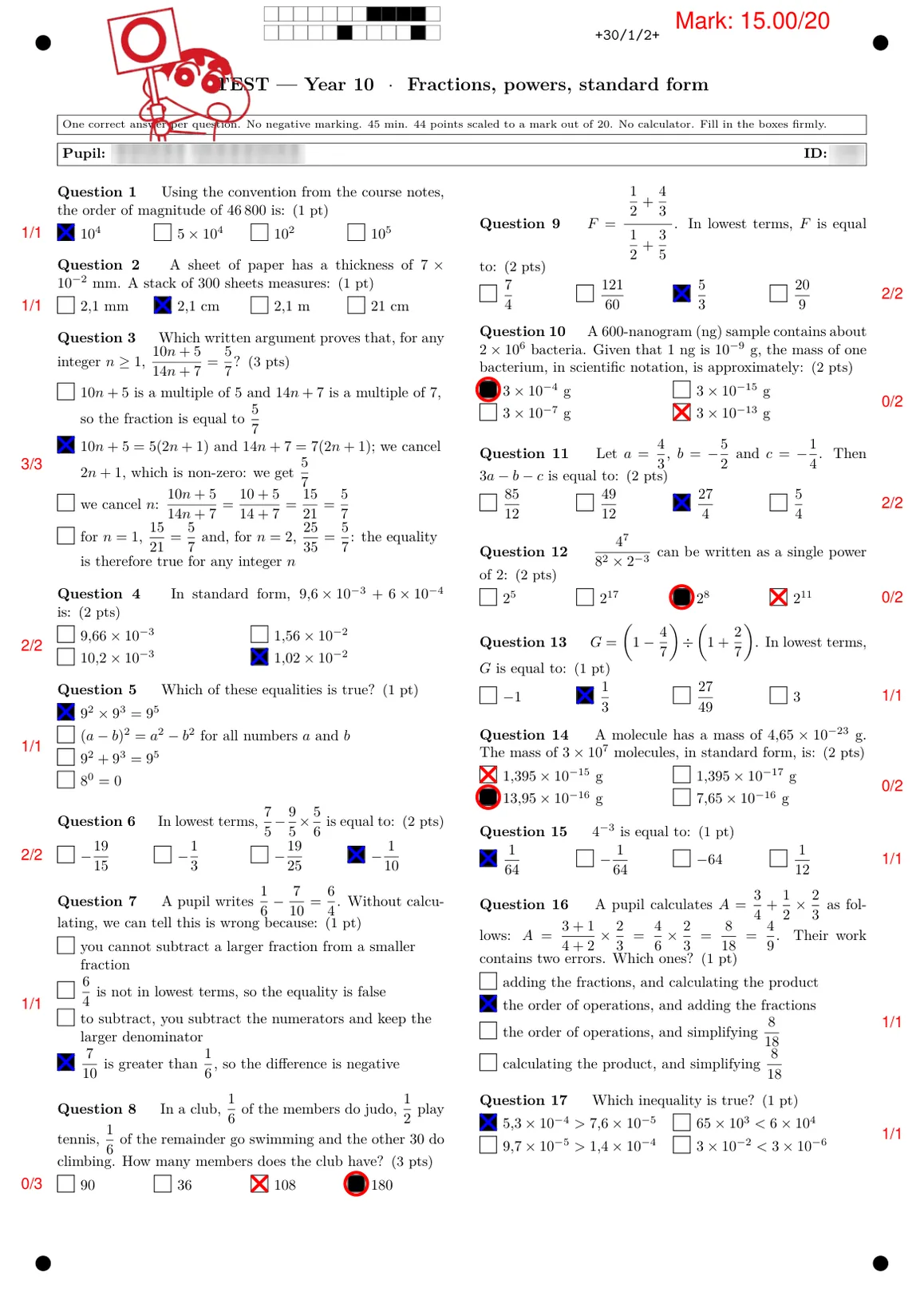
The same 30-question multiple-choice test (fractions, powers, scientific notation), across my two 3e classes (the equivalent of 5e in Luxembourg, S4 in the European Schools). The tally of ticked boxes shows which errors to review, and with how many pupils.
English translations of the original French documents.
Below are the four most demanding questions out of the thirty, numbered this time as in the reference paper (questions are shuffled from one script to another): they are the ones that best show what to review. For comparison, the average success rate per question is 70% in fractions and 74% in powers. Select a question to see how the class answered.
Question 26 (3 points). In a club, 16 of the members do judo, 12 play tennis, 16 of the remainder go swimming and the other 30 do climbing. How many members does the club have?
What I do with this. More than half the class chose the same distractor: this is not a matter for a small group, but a concept to review with the whole class. I revisit it using a bar model, where the remainder becomes a new unit and “16 of the remainder” is written as a product.
Numbers counted script by script from the ticked boxes. A given pupil may appear in more than one row.
| Identified error (question in the reference paper) | Pupils | Decision |
|---|---|---|
| Forgotten or incorrect unit conversion (No. 15 and No. 27) | 41 · 72 % | review with the whole class |
| Mantissa left outside the interval from 1 to 10 (No. 16, 20 and 24) | 35 · 61 % | review with the whole class |
| “Fraction of the remainder” read as a fraction of the total (No. 26) | 32 · 56 % | review with the whole class |
| Dilutions counted 5 times instead of 6 (No. 5) | 19 · 33 % | targeted workshop |
| 600 written without its factor of 102 (No. 15) | 18 · 32 % | targeted workshop |
| Addition without aligning powers of 10 (No. 16) | 17 · 30 % | targeted workshop |
The online course notes with their interactive figures, the PDF course notes, the exercise sheet in two versions (full and lighter version), the worked solutions, the Gammes du soir (evening drills) and, on the teacher’s side, the lesson guide and the board plan for each lesson, inspired by Japanese bansho.
16 model write-ups · full exercise sheet (21 p.) and lighter version (11 p.)
19 model write-ups · full exercise sheet (13 p.) and lighter version (8 p.)
I gladly contribute to developing shared schemes of work and common year-group assessments. Using shared criterion-referenced marking grids helps ensure consistent marking across classes, and analysing the results together helps me identify which topics need consolidating with my pupils.
I take care to structure my course notes, practice materials and assessments so as to guide independent study as effectively as possible. Expectations are made explicit and what has been mastered is clearly set out, giving parents practical reference points to follow and support their child.
Collaborative work matters a great deal to me: I gladly share my teaching materials while drawing on my colleagues’ experience to enrich my own practice. In the same spirit, I adapt my teaching sequences to the school’s routines, cross-curricular projects and the choices of the mathematics department.
My approach has not developed by chance: it has been built by combining my classroom experience with regular reading of educational research. These landmark publications in didactics and cognitive psychology guide how I structure my course notes, grade the difficulty of my exercises and make use of my assessments:
Research on cognitive load shows that a pupil left alone with a new concept quickly overloads their working memory. Hence the use of explicit instruction (course notes presented and explained, “On lit…” (“it reads…”) / “En clair…” (“in plain words…”), oral discussion) combined with targeted hands-on exploration to observe an invariant or a counterexample.
Studying worked examples before practising reduces cognitive load for beginners. Hence the model write-ups in the course notes, and worked solutions that explain which tool is chosen and why.
Varying just one thing at a time helps pupils see what really matters in a concept; mixing exercises from different chapters requires them to choose the right method. The three tracks allow each pupil to practise at their own level.
Self-testing is more effective for retention than re-reading. Hence the self-tests on the website and the Gammes du soir (evening drills); and because the course notes, exercises and worked solutions share the same model write-up numbers, pupils can find the method they need on their own.
Assessment serves to identify what needs revisiting. For in-class tests, the individual feedback sheet breaks down each question criterion by criterion and asks the pupil to explain their mistake; for multiple-choice tests, the selected answers show which misconceptions to review with the whole class and which to address in small-group workshops.